

President Donald Trump touted new restrictions on large investor homebuyers in a speech on Wednesday morning, as his administration focuses on the housing crisis ahead of the midterm elections.
Trump announced the new measures during his special address at the World Economic Forum in Davos, Switzerland, after signing an executive order that restricts mortgage lending for institutional buyers of single-family homes.
“Homes are built for people, not for corporations, and America will not become a nation of renters,” said Trump. “That’s why I have signed an executive order banning large institutional investors from buying single-family homes. It’s just not fair to the public. They’re not—they’re not able to buy a house.”
The new order does not ban institutional home purchases outright, but rather limits conventional mortgage guarantees for such transactions. It would not impact cash buyers or investors who use financing that is not guaranteed by Fannie Mae and Freddie Mac.
During his wide-ranging speech in Davos, Trump also reiterated his insistence that home values should not be allowed to fall, in order to preserve the wealth of existing homeowners, who enjoy near record-high levels of equity.
“The house values have gone up tremendously, and these people have become wealthy,” he said. “Every time you make it more and more and more affordable for somebody to buy a house cheaply, you’re actually hurting the value of those houses, obviously.”
He added: “If I want to really crush the housing market, I could do that so fast, and people could buy houses, but you would destroy a lot of people that already have houses.”
Trump in his speech did not mention other ideas that the administration has floated to improve housing affordability, including proposals to allow homebuyers to keep their old mortgage rate when they move, and offer penalty-free early withdrawal from 401(k) accounts to fund a down payment.
“Housing affordability played a less central role in President Trump’s Davos speech than many expected,” says Realtor.com® senior economist Jake Krimmel. “Still, the president used the forum to outline a handful of housing-related ideas and to frame what he sees as the key headwinds facing the market.”
White House spokesman Davis Ingle told http://Realtor.com earlier this week that Trump “will soon unveil new policy initiatives that will restore the American dream of homeownership.”
“President Trump pledged to improve housing affordability for Americans still reeling from Joe Biden’s economic disaster, and the administration is committed to exploring every tool possible to deliver for the American people,” says Ingle.
Executive order restricts mortgages for large investors
On Tuesday night, hours before appearing in Davos, Trump signed an executive order that seeks to block “large institutional investors” from purchasing single-family homes that could otherwise be purchased by families.
The order directs government-controlled mortgage giants Fannie Mae and Freddie Mac to stop guaranteeing mortgages for purchases of single‑family homes by large investors.
Far from an outright ban, the order would only impact institutional investors who seek conventional mortgages to purchase single-family homes, with no effect on buyers using cash or alternative financing.
The order does not specifically define large investors, but rather instructs Treasury Secretary Scott Bessent to come up with a definition in 30 days. Bessent has said in interviews that the restrictions would not apply to small investors with a dozen or so rental properties.
While the order is limited by the scope of executive authority, it does ask for congressional action to codify a de-facto ban with legislation. That outcome seems uncertain after the failure of several Democrat-sponsored bills seeking a ban.
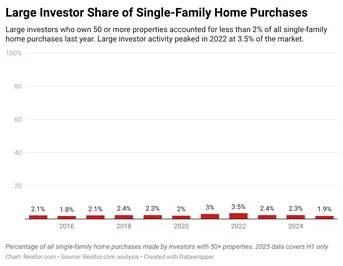
The housing economist Krimmel says that the likely market impact of the new executive order “remains limited.”
“A large share of institutional purchases are all-cash or financed outside the agency mortgage system, meaning they could fall outside the reach of this order,” says Krimmel. “As a result, while the policy may be politically resonant, it is unlikely on its own to significantly boost inventory or improve affordability for most buyers.”
As well, institutional home purchases are already relatively rare. A recent Realtor.com analysis found that large institutional buyers accounted for just 2% of all home purchases in the first half of last year.
But over time, the changes could tilt the market toward owner‑occupants and small landlords, marginally reshaping competition in certain tight Sun Belt and Midwest markets where institutional buyers are most active.
The National Rental Home Council, a trade group for large single-family rental operators, responded to the order in a statement saying that large investors, who own less than 1% of the nation’s homes, “are not the cause of America’s housing shortage.”
“For many families, single-family rentals provide stability and space for family formation and a launchpad to homeownership,” the group said. “Our country needs more housing investment, so we look forward to working with the administration and other policymakers to expand rental options and create real pathways to homeownership. We will continue to do our part by preserving existing homes and building new homes to expand the nation’s housing supply.”